An article on Delaware and its peculiar tax policies with their entailing impacts.
INTRODUCTION
Recently, the British Virgin Islands and the Cayman Islands have become subjects of ongoing discussions due to their extensive tax loopholes, leading to debates about how businesses exploit these benefits to evade their due tax obligations. However, it’s not just remote islands amid the ocean that attract wealthy individuals to stash their wealth. A brief examination of our borders reveals a similar trend emerging as well. Delaware, famously known as the First State, is a prime example of how some states exploit their federally-bestowed powers to seal an unfair economic advantage for themselves by sometimes relying on unethical practices and laws.
Although under constant scrutiny for their ‘business-friendly’ and ‘usurious’ tax laws, A deep dive into their history shows how the state came about such policies and the difficulty in bringing necessary reforms.
TAX EVASION
Delaware has more subsidiaries registered than its no. of citizens.
Yes, that’s right. In addition, The frequency of these ‘subsidiaries’ propping up is more than the rate of GDP change of the state. Both statements above imply that these ‘subsidiaries’ motives are well beyond serving the local public and sales within the state.
1.1 million companies and 65% of the S&P call Delaware their home. The reasons for such absurd numbers are the usurious and ‘business-friendly’ tax laws it offers to businesses. One such law is the ‘zero tax policy’ on incomes (interests, royalties) derived from using Intellectual Property (IP). IP covers all intangible assets like securities, trademarks, logos, and registered brands. Although this small measure might seem insignificant, it costs the state around $9.2 billion over a decade.
Corporations take advantage of this loophole in two significant ways:
1. Asset Isolation strategy — Companies transfer their interest-earning assets to a subsidiary, often referred to as a Passive Investment Corp. (PIC) in Delaware, where the source of income becomes non-tax deductible. And further on, companies can access that untaxed wealth by simply taking a loan from the PIC and deducting the interest paid from their state tax liability.
2. Captive REIT strategy — Companies establish a PIC in Delaware and transfer their income-generating real estate assets to a REIT (Real Estate Investment Trust), whose central ownership is the PIC. REITs face no income taxes if they share more than 90% of their earnings with the shareholders (mostly the PIC). And in addition to that, Delaware state also does not levy tax on income from interest-bearing assets. The combination of these two concessions makes taxes imposed almost non-existent.
3. Due to its zero-tax policy on Intellectual Property, corporates also find profit by registering all their patents in Delaware and not paying any taxes on the income derived. Therefore, Delaware has reportedly the “highest frequency of patent assignments to Delaware-based owners per dollar of state GDP.”
 |
|---|
| CT Corporation building which has more than 300,000 companies registered, including Apple and Google |
ANECDOTAL EVIDENCE
This section briefly explains some real-world examples of how corporations exploit these loopholes.
WorldCom:
The spectacular failure of WorldCom and its accounting frauds is a known affair. But lesser known is their strategy to evade billions of tax dollars.
Surprisingly, it was not the regulators but creditors from MCI Communications Corp (now Verizon) who blew the whistle on WorldCom, warning about its fraudulent accounting practices. Shortly after, the SEC launched a full investigation into its accounting practices and found that it employed a ‘Delaware PIC’ strategy to evade taxes.
According to reports, WorldCom has established a subsidiary, ‘WorldCom Brands LLC,’ in Delaware, which received royalty payments from other out-of-state WorldCom subsidiaries. The reason stated by WorldCom behind these payments was to use an ‘intangible asset’ owned by WorldCom Brands. Later, investigations revealed that the intangible asset was termed ‘Management foresight,’ the whole arrangement was a sham and no different from a PIC operating to launder money and evade taxes. Further investigations found no formal agreement between the subsidiaries and the PIC, further questioning its legitimacy.
Between 1981 and 2001, the PIC reportedly earned around $20 billion from other out-of-state subsidiaries of WorldCom. Remember, these earnings are tax-exempted.
Consequently, WorldCom had to pay for its follies, and when the Bankruptcy Court Examiner’s report became public, i.e., in 2005, states pursued litigation charges against WorldCom. In 2005, WorldCom made a deal with 18 states and the District of Colombia to pay out $460 million as compensation for the lost tax money. It was also required to transfer its corporate headquarters ownership from Jackson to Mississippi.
Although the PIC strategy showed positive results for WorldCom, its fraudulent accounting practices and negligence caused regulators and the Court to halt its operations.
 |
|---|
| WorldCom was acquired by Verizon in 2006 |
Toys R Us:
Toys R Us Inc. established a PIC in Delaware as Geoffrey LLC. Geoffrey LLC had copyrights of all Toys R Us assets’ trademarks, brands, and logos. It received royalty payments from out-of-state subsidiaries for using these intangible assets. Moreover, the received royalties were deemed tax-free and could be withdrawn anytime by the holding company just by taking a loan from the PIC.
Even though it might seem similar, what differentiated it from WorldCom Brands LLC was its legal agreement between the subsidiaries and the PIC. The legal deal strengthened the credibility of the arrangement and made it harder for regulators to challenge it.
It was in 1980 when South Carolina (Toys R Us headquarters) first challenged the PIC strategy. As a part of its tax return to South Carolina, Toys R Us claimed a tax deduction for its royalties’ payments to its Delaware PIC. Although South Carolina allowed the tax deduction, it challenged the PIC strategy as Toys R Us had already set up an economic nexus with South Carolina and hence, should heed South Carolina tax laws. Additionally, Toys R Us had already established a solid economic footprint in South Carolina via the widescale usage of its trademarks and logos, thereby shaping the state’s economic landscape.
Finally, the Court decided to side with South Carolina regulators and break up the Delaware PIC strategy. The Court action followed litigation charges from other states as well.
Even though both companies had to concede penalties and make payments for their malpractices, they only represent a tiny fraction of all the PICs operating in Delaware. The main reason is that once a company operates from another state, home state laws are no longer enforceable, making them almost invincible from regulators in their home state.
Hence, even today, Geoffrey LLC holds multiple trademarks and Toys R Us Inc brands.
 |
|---|
| Toys R Us closed down its services on June 2018 |
DIFFICULTY IN FINDING SOLUTIONS
Although Delaware might seem harmless, it has become the epicenter of corruption and money laundering, thanks to its ‘twisted’ tax governance. Regulation officials have often complained about the lack of transparency in their structures, making it difficult for authorities to track suspected criminals and offenders. Problems faced by regulators in tracking down corporate malpractices and corruption often converge to a single reason ‘Ownership secrecy’ -
1. Setting up a company in Delaware is much easier than in other states and does not require disclosing beneficial ownership of the company.
2. All anyone requires is a permanent resident of Delaware, willing to act as an agent. Company Service Providers (CSPs) now offer many solutions to provide agents and spaces for corporates to set up subsidiaries there.
In addition, Delaware has gained a notorious reputation internationally for its secrecy laws and practices. International police agencies constantly complain of facing a roadblock while investigating corrupt practices and money transfers.
But how does Delaware’s corporate governance system differ from other states?…
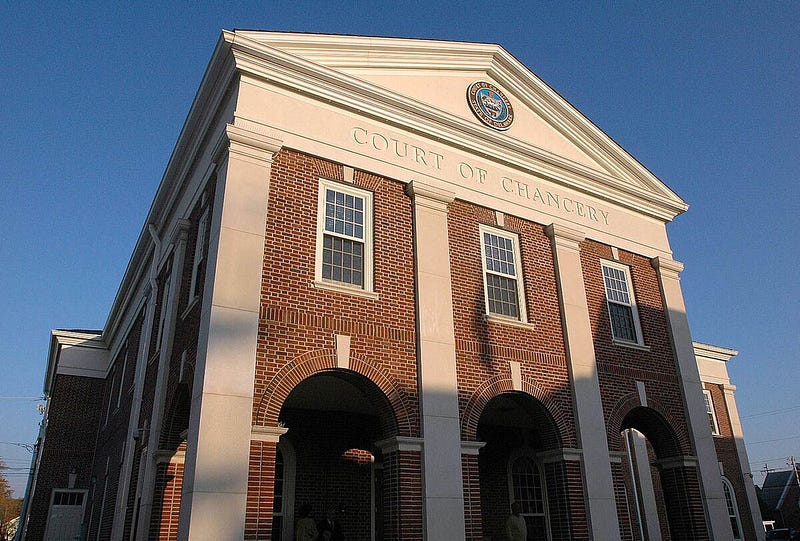
The infamous ‘Court of Chancery’ comes in here, directly responsible for all Delaware’s corporate laws and regulations.
Court of Chancery
The Court of Chancery is one of the three legal courts in Delaware dedicated to solving corporate grievances. It has gained an international reputation as the go-to Court for settling corporate disputes. Since Delaware has become a hub of corporates, with 65% of Fortune 500 companies calling it home, the Court’s decisions extensively influence the country’s economic landscape.
Title 10, Section 341 of the Delaware Code states that the Court –
“shall have jurisdiction to hear and determine all matters and causes in equity.”
The Court is non-jury and consists of 12 judges serving a 12-year term. Being a non-jury court, the judges can rule out proceedings or modify regulations. Moreover, Litigants can rely on fair and unbiased decisions from skilled lawyers with more than 200 years of knowledge in court rulings during any corporate dispute involving merger acquisitions, shareholders complaints, and commercial litigations.
Most cases coming to the Court revolve around issues regarding Merger-Acquisition matters, shareholder grievances, and suspected breach of duty of the board members. Being a non-jury court profits them by not needing to educate a jury about the complexities of corporate governance, with its measures and relaxations. Hence, the judges solely wield the supreme power to decide on any case.
Any jurisdiction passed from the Court of Chancery regarding tax and corporate governance almost always comes to pass and regularly influences the Supreme Court, i.e., the next higher Court. Moreover, all tax regulations are routinely reviewed by a voluntary association known as The Delaware State Bar Association, making it easier for corporates to show and influence any required changes and kill significant reforms.
 |
|---|
| Office of the Court of Chancery in Wilmington, Delaware |
CLOSING THE LOOP
Even after gaining an infamous reputation as a domestic tax haven, lawmakers seem reluctant to pass legislation to rebuild its reputation. Delaware’s tough stance in resisting change forces other states to devise their initiatives and ways to retrieve the lost money from the PICs. Some of those initiatives are listed below -
· ‘Addback’ Rule — Many states are applying this new rule which requires all companies operating within the state to add the payments made to their Delaware PICs (or any other state where the money will not be taxed) in the form of royalties, back to their state liability accounts where it will be taxed accordingly.
· Combined Reporting — This is similar to the ‘add-back’ rule and requires all companies operating within the state to combine and include all their financial statements, including out-of-state subsidiaries, in their tax liabilities. Further, the out-of-state incomes would be verified and taxed accordingly. This method proved to be a decisive blow to the tax havens as companies now find no incentives to relocate to other states, where they will be taxed the same.
CONCLUSION
Even though these initiatives might seem like a game-changer for tax havens, the execution of these ideas paints a whole new different picture; Owinf to the solid federal nature of the US government, each state has its way of executing these laws, with the degree of enforcement varying indefinitely across the states. Hence, the corporates are always safe as they can always find a better location with better tax benefits.