Qualitative assessment of recent bank failures
The month of March was a rough patch for most nations. With high inflation and rising interest rates, everyone was affected in some way or another. And if that was not enough, the failure of some central banks made the crisis even worse.
Below I have prepared a brief qualitative assessment of the failure of some of these significant banks (Credit Suisse, SVB, etc.), whose untimely demises had huge impacts on our economies and, consequently, our livelihoods.
I’ve given a brief qualitative assessment here, as quantitative assessments usually involve a lot of data that can make it difficult to read.
Credit Suisse:
It was mid-March when Credit Suisse was sold to its rival, UBS, following a string of failures. Its failure was like a scene played out of a drama as the whole world watched in awe the downfall of one of the most reputed banks in history.
Reasons:
As we trace back to uncover the potential reasons behind this event, we come across a logical sequence that should have alarmed investors and regulators well before and may have just prevented this from happening.
It all started in 2019 when Credit Suisse faced severe allegations of scams and fraud in their books. This forced then-CEO Tidjane Thiam to resign and caused a dip in shareholder confidence. This followed a rolling set of executives, each with a short service stint. And just when the bank seemed to be recovering from its earlier losses, in 2021, 2 of its significant investments, Archegos Capital and Greensill Capital collapsed, adding up to a total loss of 1 billion USD.
Investor confidence again plummeted when in January 2022, then-Chairman Antonio Horta-Osorio was found breaching Swiss and British COVID-19 guidelines. Chairman Antonio Horta-Osorio resigned, further increasing speculation and doubts about the bank’s management.
From July to August 2022, sudden rumors broke out that Credit Suisse was on the verge of bankruptcy and in its last breaths. This caused panic among investors, which followed a series of money withdrawals and the selling of bank stocks from investors, incurring the bank a loss of up to $119 billion.
Determined to steer its course, the bank decided to increase investors’ confidence and liquidity levels by announcing that it would borrow a loan of up to $54 billion from its top shareholders. But as fate would have it, its principal shareholder Saudi National Bank refused to lend more money as it would break regulations by increasing its percentage share more than it is allowed to. This further deteriorated the crisis and convinced the regulators that the bank had reached a dead end and was facing impending doom.
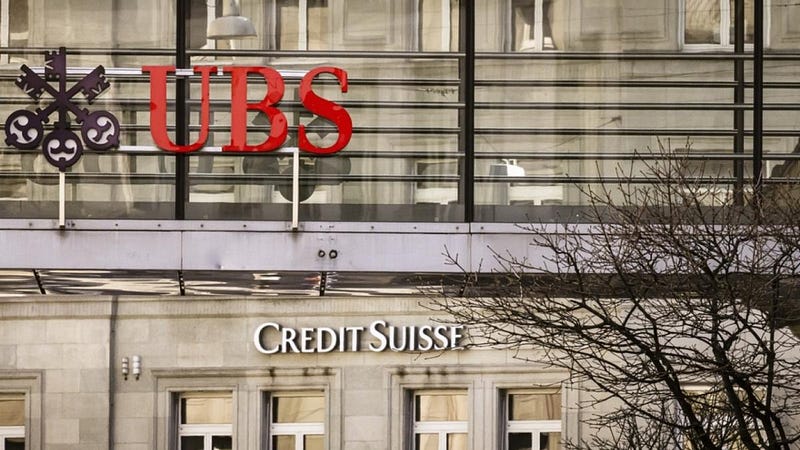
Hence, on March 2023, Swiss regulators voted on selling the bank assets to UBS, without shareholder approval, for an amount of $3.3 billion. Although this amount might seem hefty, it is paltry compared to the combined value of the bank’s total assets, $1.4 trillion(AUM).
 |
|---|
| UBS agrees to buy Credit Suisse for $3.3 billion |
Silicon Valley Bank:
Silicon Valley Bank, one of the largest banks in California, was closed and collapsed on March 10, 2023, on the grounds of bankruptcy. Although the bank was never allegedly involved in fraud and corruption, its failure is a classic example of mismanagement of risks and threw a new light on how we perceive ‘safe’ investments and how they play out in the long run.
Silicon Valley Bank was a commercial bank based in California that provided services primarily aimed at venture-backed startups and became their go-to place for deposits. Soon, the tech lender became the largest bank for deposits in California.
Further, to generate income from its deposits, the bank decided to invest its vast deposits in long-term government bonds and HTM(Hold-to-maturity) securities, primarily because of the safety of these assets. After all, the failure of government bonds was never a possibility.
This proved a fatal mistake as the upcoming recession and bearish market completely devalued those HTM and government-backed securities.
From mid-2021, when the Fed started increasing their interest rates to tackle inflation, people’s purchasing power reduced drastically, causing a steep decrease in demand for long-term securities and, consequently, dropping their market value. Startups started to feel the heat of this new season as venture capitalists stopped funding more startups due to the fear of recession.
Realizing this tumultuous time, tech startups started withdrawing money from their accounts at SVB, which soon caused a liquidity crisis for the bank. Hence, it was forced to sell its long-term investments to meet withdrawal orders. This incurred enormous losses for the bank as government bonds were valued much less now than previously, thanks to the rising interest rates. Soon word got out on the street that SVB was facing a liquidity crisis and was selling its assets to make ends meet. This further dropped investors’ confidence and deepened the pit SVB was in.
Hence, to prevent more damage and a full-blown bankruptcy, the DFPI (Department of Financial Protection and Innovation) seized and collapsed the bank on March 10, 2023. The FDIC (Federal Deposit Insurance Corporation) insured depositors of up to $250,000, depending on their deposit level.
 |
|---|
| Silicon Valley Bank collapsed on March 10, 2023 |
Signature Bank:
The fall of Signature Bank, also referred to as the 3rd most significant banking failure in history, was no more than a part of the chain reaction set by the fall of SVB.
Signature Bank was founded in 2001 as a private client services bank with deep ties to the real estate and legal industry. From 2018 onwards, it started publicly trading cryptocurrencies and DeFi, turbocharging its annual revenues and deposit growths. The bank also created a 24/7 crypto exchange where users can publicly trade crypto and digital assets. This saw their AUM(Assets Under Management) rise to $110 billion and digital asset deposits of $16.5 billion by the end of 2022.
Although the bank was never alleged with fraud charges, its heavy involvement with the crypto industries worried the regulators for a long time. And as the failure of SVB sent shockwaves around the world, this bank was also hit by a run on its deposits by investors, withdrawing up to $10 billion in a single day. Fearing its demise would destabilize the crypto markets, owing to its heavy involvement there, the FDIC shuttered the bank on March 12, 2023, and brokered its sale to Flagstar Bank, a subsidiary of New York Community Bancorp.
The FDIC also assured customers access to deposits and uninterrupted service throughout.
 |
|---|
| Signature Bank was the 3rd largest bank failure in U.S history |