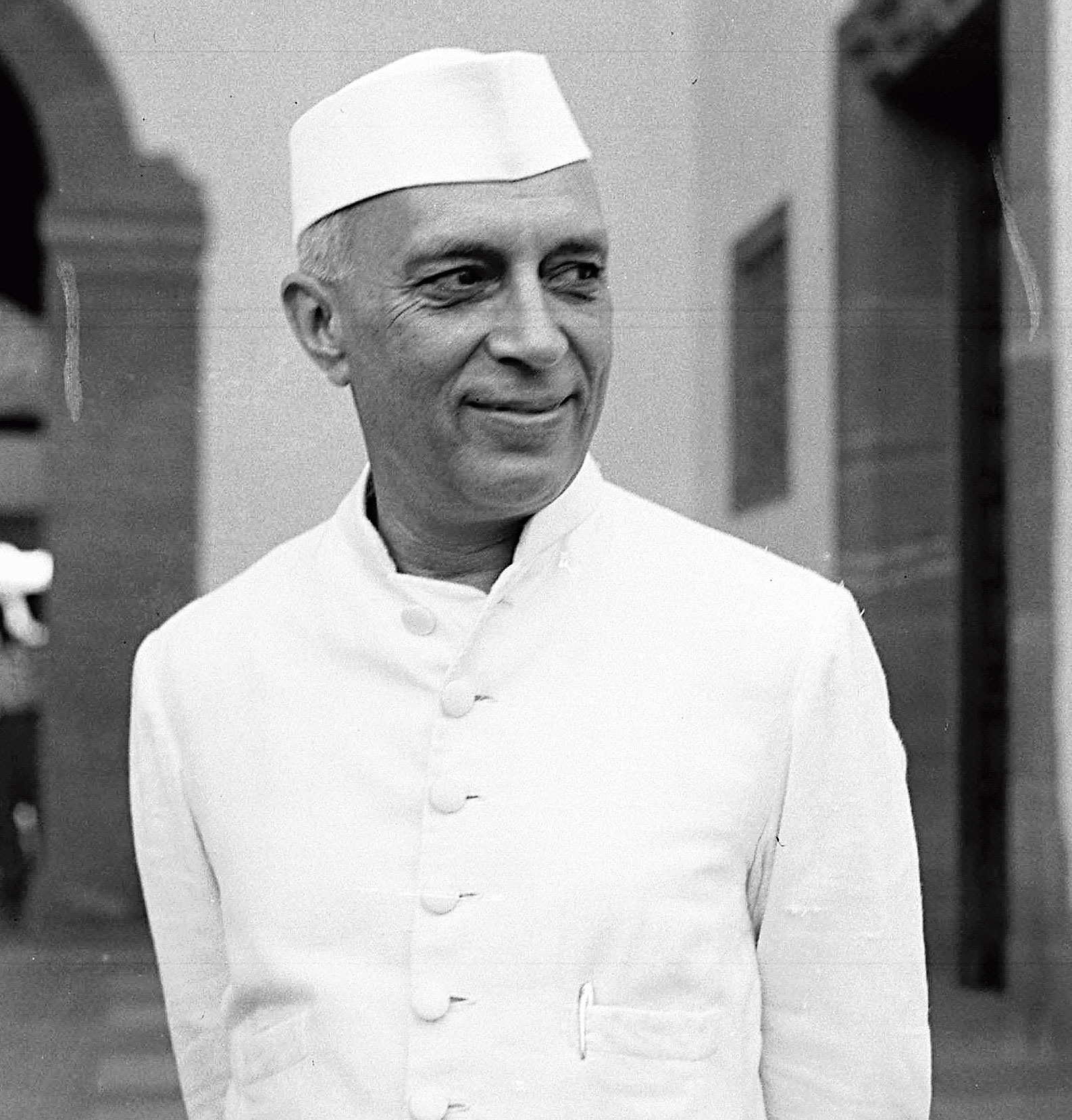
This is a recollection of the major events and personalities involved in the time of post-independence era which perhaps, shaped the way…
British left a child to grow up itself?
After 1947, when India was finally relieved from the clutches of the British Raj, it was still a baby. Even though the enthusiasm and excitement among the people were quite high, it was a monumental task to rebuild the country, which quite frankly, was ruined (thanks to the British).
The leaders of the country especially Mahatma Gandhi, who still garners the greatest respect from any Indian knew what lay ahead was not an easy road to past Indian glory, but a nation ridden with hunger, poverty, and most importantly, enemies in its neighborhood.
 |
|---|
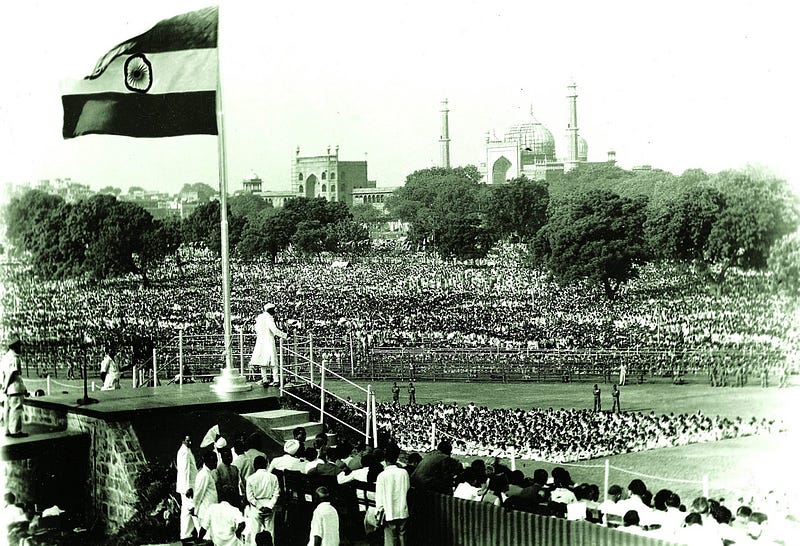
| India’s first Independence Day — 15th August 1947 |
Nehru joins the party
It is still unclear if Nehru was the right person to lead India (considering his ‘all-talk’ attitude and overleaning towards ‘socialist’ solutions). But it is widely regarded that, Gandhi himself gave the deciding vote to Nehru and evidently, asked his rival Sardar Vallabai Patel to step down, citing ‘Nehru will not settle for anything less than the PM’. In fact the Pradesh Congress Committee (PCC), the state-level unit of INC unanimously voted for Patel to be the PM.
Out of the 15 PCC members, 12 voted for Patel to be the PM, while the other 3 abstained.
You might be tempted to think why Gandhi wanted Nehru to become PM and not Patel. You see he wasn’t wrong to reject the polling results and go against the popular vote. But there were subtilities, that only Gandhi saw (and for good).
Firstly, Nehru was not a typical Indian back then. He was the son of a prominent Indian lawyer. He received his schooling from Harrow School, England, and went on to study Natural Science at Trinity College, Cambridge, and later pursued a career as a lawyer.
So, by far and large, Nehru was the most ‘British’ an Indian could get during those days. And that’s precisely why Gandhi wanted him as the PM and not Patel, who was among the common men. Gandhi realized that after Independence, India would need allies to stay afloat in the global political scene. Not to mention the numerous wars and instability it has to face, before finally unifying its states and people. Therefore, India needs a man who can negotiate well with the power brokers of this new era. And Nehru, with his illustrious upbringing had a better chance in sparking a relationship with other leaders, who also had a similar upbringing as well.
It might sound ridiculous, but it’s the best India could hope for (at least Gandhi did). And it worked! Due to Nehru’s socialist outspoken ideologies, the USSR became close allies with India and became its trade partner (the USSR saw it useful to have an ally in SE Asia, perhaps due to the Vietnam War?)
Might sound surprising but the Bolsheviks had found a good trade with newborn India, for defense supplies and natural resources.
‘The enemy of my enemy is my friend’ — Old Proverb
 |
|---|
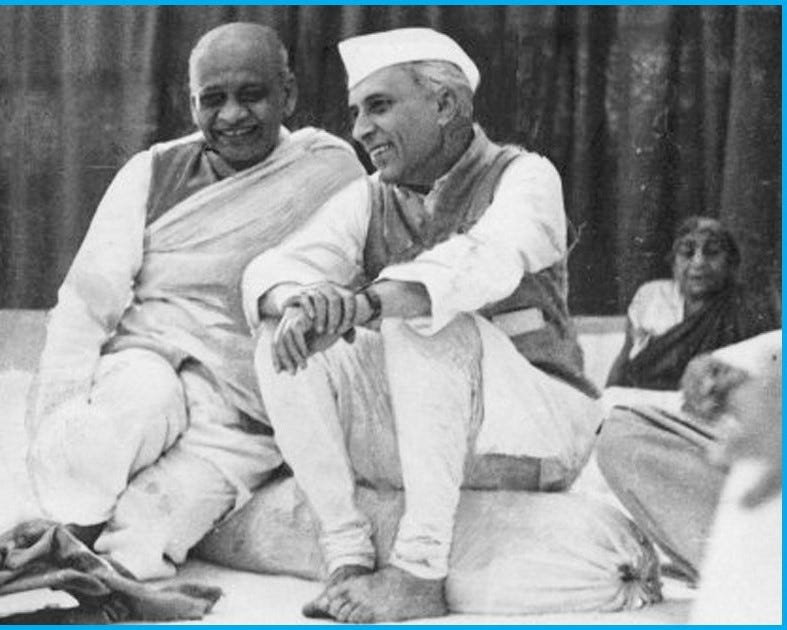
| Nehru (right) and Patel (left) |
Now what’s with the economy?
India after 1947 was more focused on building its economy not by including/starting new industries and avenues of trade. But by improving the current production state, especially in heavy industries, where the government hoped for great potential (big mistake).
Therefore, following the Japanese Model, India started investing huge amounts in heavy industries, and factories that might help increase production levels. The improvement/involvement of the service and agricultural sectors was nowhere to be seen.
Although heavy industries were the main focus for the first few years, things were not going fine (as they planned to). Firstly, corruption was rampant. The ‘legendary’ Indian bureaucracy was relentless in holding its status quo and its shady relationship with the power brokers of Delhi put a big question on the future of the Indian Economy. Moreover, there was a much bigger devil hiding and plaguing India from the shadows.
Socialism and Nehru
Nehru was a staunch believer in socialistic views of society like Equality, Non-monopoly, etc. But as Karl Marx himself would have to accept, the key is in the execution not ideation, and not everyone is good at it (certainly, not Nehru). First was his stance against free markets. He wanted the state to regulate the food supplies so that everyone gets an equal share (USSR vibes!). That, as we all know turned out to be disastrous in terms of innovation and distribution. As Nehru’s successor, Shastri himself confessed once, socialism is best when there is free competition in the market (capitalism eh?).
And Nehru was hard to move, he had the public backing for his boisterous speeches about socialist ideal policies, most of which he would have never fully seen through during his 12-year-long career. Even though people like Patel and Shastri always warned him about his negligence towards the agrarian sector, Nehru never really showed interest in the dirty ground-level work of building a nation’s resources, rather more towards the promotion of idealistic subjects like Science and Education (that helped).
And more painful was the rampant corruption that occurred during this period by the politicians, businessmen, etc. Politicians were the bosses of their lands and therefore, got involved in shady transactions and bribes, without any restraining authority. In fact, during the 1950s, the situation was so bad that common people thought it was okay to pay bribes/extra money to get any work done involving the public department.
 |
|---|
| Nehru in Punjab, giving a speech |
Licence Raj
The License Raj is a pejorative to the time in India when businesses were required to obtain permits and licenses from the government, which were mostly difficult to obtain. Up to 80 government agencies had to be satisfied before a business was allowed to produce goods and even after that, the state regulated the production levels.
Even though C. Rajagopalachari of Madras Constituency wanted to establish the License Raj to protect individual domestic small-scale businesses from monopolistic overloads, the implementation and the involvement of the Indian bureaucracy and agencies made it an endless game of cat-and-mouse to obtain a permit. Not to mention, heavy corruption made it almost a system where businesses could obtain permits by only paying bribes (which were outrageous). Therefore, starting a new business was a right only reserved for the rich.
This policy helped the rich of Bombay to maintain their power and position due to a lack of competition. And as long as you have a fat pocket, you need not worry about the politicians.
Shastri comes to save the day?
Shastri knew the problems of the License Raj when he came to power, but unfortunately, the idea of socialism was so much imbibed in Congress back then and the general Indian public that inviting capitalistic ideas would mean suicide. Moreover, India then had a much bigger challenge of improving their agricultural sector as the nation was practically feeding on imports from the US. One politician then rightly said that Indians were practically living from ‘ship-to-mouth’ (American ships bringing food supplies). Infact, the Americans found a good trade in selling their excess produce at fat rates to India, in rupees.
Hence, Shashtri knew India had to have an independent source of food and agriculture to feed its 500+ million population. Moreover, all these imports were weighing heavily on India’s current account deficit. By then, India was living on a ‘free money’ idea, where every time it faced the need, it would take loans from the IMF or World Bank. But this time, with the recent Chinese Invasion, the 1965 Kargil War, and the Vietnam War, things were not the same. Not everyone believed in India’s ability to pay back its accumulated debt and clear its balance sheet. That’s when Shastri finally had to accept something he would never see in his lifetime, but his successor, Indira Gandhi implemented, the devaluation of the Rupee.
 |
|---|
| Lal Bahadur Shastri — 2nd Prime Minister of India |
Devaluation of Currency — Example 101
Imagine this — For example, let’s say 1 rupee = 1 dollar. And an item ‘A’ costs 1 rupee ($1) in the Indian market. So a foreign investor has to pay $1 to buy that product..simple right? Now, After the devaluation, let’s say $1 = 1.5 rupees (50% devaluation of rupee)..now for the same item costing 1 rupee in the Indian market, the foreign can get it at $0.66. Hence, in simple, exports from India became cheaper which brings in money from foreign investors. Now coming back to the topic….
Devaluation of the Rupee
Shastri died on January 11, 1965, and on June 6, 1966, Indira Gandhi devalued the rupee by 36.5%. For economists and politicians of then, it was not a surprise as they had anticipated this move during Shastri’s reign. It was necessary, India’s current deficit was more than it could take and now with the changing world order and new enemies with China and Pakistan, it had to prioritize the rebuilding of the economy.
The main reason, though unpopular was to reduce the current account deficit India faced, which was also forced by the World Bank’s failure to supply food grains to India promptly.
The devaluation helped in reducing the budget deficit, and hence now more money can be flown into the much-needed agricultural sector coupled with M S Swaminanthan’s breakthroughs in synthesizing high-yielding wheat crops, Indian Agriculture saw a boom finally (Green Revolution).
Shastri’s wish has finally been fulfilled.
Still, there was a food shortage and famines, and India was still dependent on the US’s goodwill in sending shipments. But the Vietnam War was affecting that. It is said that Gandhi’s (Indira) increasing criticisms of US bombings on Vietnam caused then-US President Johnson to hold up on food supplies and forced Gandhi and India to ramp up their agricultural production. This bitter standoff did prove useful as India started becoming more reliant on its produce and infact, during the 1970s food famines, India bought grains from the US commercially rather than depending on grants.
But Indira Gandhi also bought something with her, that she inherited from her father — Socialism.
Socialism — 2nd phase
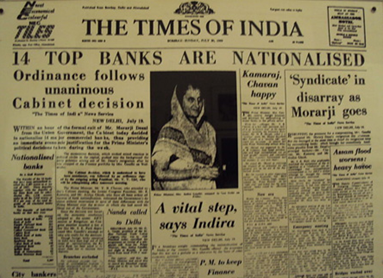
Indira Gandi was a staunch believer in egalitarian, and socialistic policies like her father Jawaharlal Nehru. Though her predecessor Shastri, believed in free unregulated markets, Gandhi went the opposite way and in fact increased the stringent rules and regulations regarding market operations, private business, and obtaining of permits. Along with this, she also nationalized the banks, as they proved incompetent in serving the poor and showed heavy favoritism towards the rich. This move was monumental in terms of the poor classes’ participation in the economy as immediately after this move, bank deposits rose by 800% and advances rose by about 11000%. The nationalization of the oil companies was to follow as well when foreign oil companies, based in India refused to supply the Indian Air Force and Navy with oil supplies during its war with Pakistan, Gandhi responded by swiftly nationalizing them and directing them to keep at least an amount in reserve for the armed forces use.
The period of 1966–75 was, therefore, characterized by a shift towards socialistic policies which finally culminated with the emergency of 1975, officially issued by then President Fakhruddin Ali Ahmed.
 |
|---|
| Cover of Times of India after the nationalizing of banks |
But corruption?
Even though the period from 1971–75, plentiful rains came down and helped the agricultural sector, India was still nowhere near in terms of development, like China, Korea, and Japan, who have built an immense economy mostly focused on exports. One reason economists argue regarding the slow growth rate of India would be the lack of interest shown towards improving the agricultural sector in terms of innovation and research and the lack of impetus on primary education. Nehru did believe in education and it’s through his efforts we have the famous IITs, IIMs, IISc, etc. But due to pressing challenges like food shortages, wars, and political in-fighting, he never could revolutionize the schooling system in India.
Unfortunately, her daughter Indira now seems more interested in putting her prodigal son, Sanjay Gandhi into power rather than improving the education standards.
Govt. of India permitted Sanjay Gandhi, to first produce the Maruti car, even when he had no prior expertise, over other renowned automobile companies.
Things might not look the best from the outside, but for Mrs. Gandhi, it couldn’t have been any better, from nationalizing oil and banks to imposing stringent rules on existing businesses saw her as the ‘Champion of the poor’, as she was then rightfully called as ‘Indira Amma’.
But as some would’ve suspected, corruption was heavy, the number of shady deals between bank officials and politicians (remember, banks are now nationalized) proved it very difficult for someone to obtain loans, etc. if it posed a challenge to the ‘crown’. And for the rich, life couldn’t have been better, bankrolling the politicians helped them attain funding, loans from these banks at almost negligible interest rates.
As always, in the case of socialism, the poor suffered the most.
The same was true with the economy as well. India was in a bad shape during the 1970s. GDP growth rate was abysmally slow at 2.14% for 1970–71 and 1974–75. Due to monsoon failure in 1972–73, GDP at constant prices declined by 1.5 percent, while agricultural production declined by 8.0 percent in the same year. Food grains production declined by 7.7 per annum in 1972–73.
In 1973–74, the industrial production also decreased by 0.2%. If this was not enough, Inflation was rampant with wholesale prices shooting up by 22.7% in 1973–74. In a nutshell, this was a disaster for the poor while the rich industrialists and elite bureaucratic Indians enjoyed their lives.
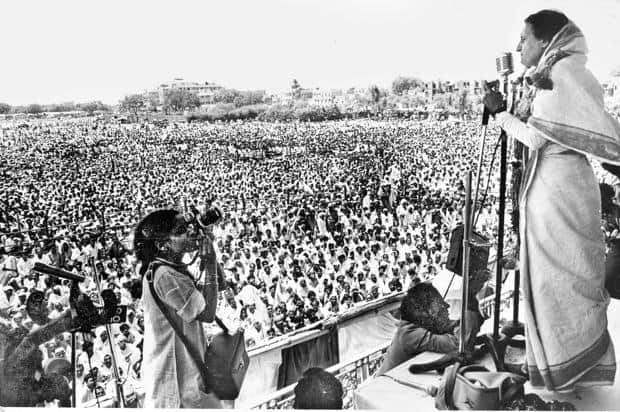
All in a while, Indira Gandhi was showing off her ‘humble’ attire and giving crowd-rousing socialist speeches in villages. “All hail Indira Amma”.
 |
|---|
| Indira Gandhi addressing a huge crowd. |
Emergency of 1975
Even though Indira Gandhi, with her ‘humble’ white sari attire was able to win over the poor of the villages. Not everywhere was the case. Big cities like Calcutta, and Bombay were becoming hotbeds for student protests due to issues like heavy inflation and rampant unemployment. Unemployment has always been an issue since independence. Due to the lack of proper private sector industries (License Raj), the youth found it difficult to find new jobs, and hence, times were characterized by long lines of queues (students) in front of offices, hoping to sit for a ‘coveted’ interview.
Also, the peasants were not happy. The droughts and famines of those years forced the peasants to live in dire poverty, while their rich landlords and bureaucrats were charging outrageous rents and taxes. Several incidents took place, most notably the Naxalbari Armed Incident, where armed peasants seized the lands and food supplies in the Naxalbari region of West Bengal.
Now Gandhi, the ‘Iron Lady’, was not someone who took time to listen to what people had demanded. According to her, the government must not bow to these ‘angry young men’. And what followed after that was absolute carnage. The police and even the army regularly patrolled the streets and broke through any protest using violence of tremendous magnitude. Thousands of students were arrested, and many were killed, but the protests continued. With movies like Pratidwandi, by Satyajit Ray, the press also began to pour out its discontentment for the regime, which accentuated the revolutionary fire even more. Leaders like Jayaprakash Narayan (JP), from Bihar, rose as the figures to disrupt Gandhi’s rule.
But the ‘Iron Lady’ is not to be tested. Gandhi’s ignorance and belief in her ideals can be sometimes comparable to that of a dictator. And perhaps, that’s where it’s headed? On the night of 25 June 1975, President Fakhruddin Ali Ahmed declared a state of emergency in the nation. And perhaps, Gandhi’s continuous chagrin for disobedient Indians and politicians was about to go away.
Immediately, after the signing, the homes of ‘defiant’ journalists, and politicians (including JP) were ransacked, and were put to jail without any trial. Multiple such arrests happened in the following days, to quell the ‘crowd’ and bring ‘order’ and ‘discipline’ to the nation.
Such terror and authoritarianism, were perhaps, a reminiscence of the old British Rule.
Conclusion
As much as I want to continue writing this blog further, I think it would be quite boring and time-consuming for the reader itself. I will continue this story in the next blog. Till then peace :).
P.S — Even though you might think from the tone of writing about the pessimism I inhabited, rest assured, I love this country and it’s just that for most Indians, post-independence history simply translates to Indo-Pak Wars, Chinese Invasion, etc.…and I wanted them to know about this.
Bye!