
A brief discussion on inflation, its impact on currencies, and the resistant nature of gold.
In recent times, the subject of gold and its inflation-hedging property has been debated quite frequently. Unsurprisingly, the ‘west overlords’ seem taunted by inflation, while other nations are failing to control it. But what exactly is the relation between gold and inflation, or more precisely, currency, as inflation is just a phenomenon related to currency?
To understand this relationship, we have to first walk the history lane to the point where this relationship was first established.
Bretton Woods Agreement
It was in 1944, as World War II was coming to an end, and world leaders, especially in the West and Europe, saw that a mass famine and economic crisis was just on the horizon. The reason for this was two-fold —
1. War-torn countries like Italy and Germany went through a complete destruction of their manufacturing and industrial sectors through continuous allied bombing.
2. ‘Hero’ countries like the US and UK have invested too much in producing and manufacturing arms and ammunition to supply the battlefield, so a sudden halt will certainly create mass unemployment and starvation.
Moreover, inflation was also a pressing issue if either of the above were to happen.
Therefore, to tackle such issues, the world leaders from 44 countries met at the United Nations Monetary and Financial Conference, held at Bretton Woods, New Hampshire, in 1944.
There, for the first time, it was established that the US dollar would be pegged to the price of gold, and all other currencies were to be pegged to the US dollar. The exchange rate decided then was $35 for an ounce of gold.
Moreover, some other important events that happened were —
- The World Bank was established then as the International Bank of Reconstruction and Development. Its main purpose was to assist and help the war-torn countries rebuild their economies in the form of loans and grants.
- The International Monetary Fund, also known as the IMF, was established to monitor the different world currencies and their exchange rates.
From then on, began the relationship between the gold price and the US dollar, and most importantly, the US dollar’s rise to power.
For almost the next 20–25 years, the US experienced a near nirvana in its economy. Inflation was under control, unemployment was decreasing, GDP was increasing at a breakneck speed, implying innovation, and most importantly, the financial system remained solid.
Fall of Bretton Woods Agreement
Immediately after the Bretton Woods Agreement came to power, it was clear who the real winner of the war was: the United States. After it was set that all currencies were to be pegged to the US dollar, every nation started stockpiling their forex reserves with US dollars. The reason for such an action was quite simple —
- Unlike its allies, the US won the war and was in good shape, as it remained almost unscathed throughout the war. Moreover, the Bretton Woods Agreement reinforced the US dollar as the primary currency in which most of the world trade was to be carried. For e.g., Gold, Oil, etc.
- People believed in the US dollar’s stability and its ability to convert its value to gold. Perhaps the large amount of US gold reserves did convince governments to have forex reserves in dollars.
But things soon started to get out of hand, leading to the fall of the Bretton Woods Agreement and, perhaps, the end of the ‘dollar-pegging gold era’ (and perhaps, something more complicated came about).
Although many reasons are attributed to its fall, below are the surmised ones —
- As more and more countries started trading in US dollars, US govt. became concerned as the total currency circulating in the market started to exceed the equivalent amount of gold present.
- During the Cold War and Vietnam War era, the US was busy competing with the Soviets in manufacturing, arms, space, wars, etc. For this, they needed to make huge investments in the respective sectors. But since the dollar was pegged to gold, they couldn’t print more money than allowed (since they needed an extra equivalent amount of gold), and hence, a lot of economic potential was considered ‘unharnessed.’
Due to the above reasons, in 1973, US President Richard Nixon announced the ‘de-pegging’ of the US dollar with gold, and now all countries had a choice to either peg their currency with the US dollar or become ‘free-floating.’
Free Floating means that the value of the currency is not dependent on any other sister currency (pegging), but market forces decide its value in the international exchange (based on supply and demand). Most countries chose the ‘free-floating’ policy, although with some limits. For example, Chinese Yen may be ‘free-floating’ in nature but has limits to which the value can fall/rise.
Inflation
‘Inflation’ may be the most popular word in finance today (Along with interest rates :)). To understand how and where inflation happens, we need to understand the following figure —
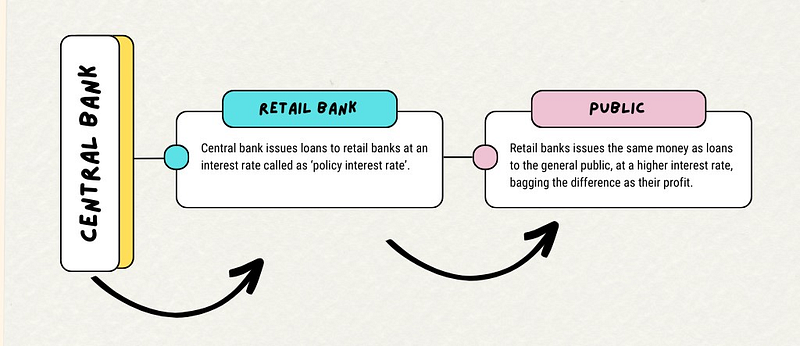
Central banks give loans to commercial banks at a low-interest rate, commonly called a ‘policy interest rate,’ and commercial banks, in return, issue loans to the public at a higher interest rate (to make a profit :)).
There you have it, now you know how banks make money?… Is it that simple? (No).
But anyway, works for our discussion. Now, during inflation, prices start to increase, and the government realizes that if consumer spending decreases, prices are bound to stabilize (less demand, prices fall). Therefore, they start to hike the interest rates of the central banks. With this move, commercial banks now find it difficult to continue lending at the same rate. Hence, they increase their rates as well. This causes a fall in the number of their customers and hence a decrease in spending activity.
But as you might know, it does not always have the same effect. Sometimes, it can have the opposite effect as well. Think of this — Interest rates hike, banks lend less, economic activity dampens, profit margins decrease, layoffs start, which leads to lesser economic activity, and you know the loop :).
Now we realize inflation is not like dieting, which we can control (or can we :)?). It’s more complicated than that (at least that’s what the govt. says).
But what can we do to prevent us from feeling its effect? Popular opinion is on investing in inflation-resistant assets like real estate (not in 2008 tho), gold, or luxury items. How well do they fare? In the subsequent paragraphs, we’ll discuss gold and why it may be the best solution out of all.
Gold
Gold is often considered as an antidote to inflation. In this module, we’ll check that out and, hopefully, solve the inflation problem.
Intrinsic Value of Gold
Imagine this: yesterday, you had an ounce of gold costing $100. Today, the market crashes, mayhem everywhere. How much do you think that ounce of gold is gonna be worth?
The answer requires some level of analysis, especially in psychological terms. Think about this: what makes gold valuable? It’s shininess? rarity? or something else? (Try to conjure up some hypothesis regarding this, please :))
If you thought of it as a combination of all the above factors, hurray, you are correct (at least in part). But to truly rationalize it, take this example: you can deflate a currency by printing more of it. But can you print more gold? No right? therefore, maybe ‘rarity’ plays a role in its price and stability. After all, a market crash does not mean anything about the supply of gold. So, prices should stay at almost the same level (if not increase).
The ‘shininess’ factor is quite an interesting one that speaks deeply about our psychological orientation. Think about this: We don’t like dull and boring things. Why? Well, because they don’t provide us with any new and exciting information to work on, in psychological terms at least. Similarly, we can think of interesting and exciting things (actions) as ‘exciting’ because they give us a whole new different set of stimuli to experience.
Now, imagine looking at a shining piece of ‘gold’ metal. Sun rays fall on it, reflections randomly occurring everywhere, and before you know it, you are awestruck by the ‘excitingness’ of its visual manifestation. Now compare it with a rod of cold-rolled steel :). Get the difference?
And that’s the very same reason why we value gold so much compared to, let’s say, iron. I know it’s a very stupid way to think of, but it’s undeniably true.
And then comes the ‘herd-mentality’ reason.
Historical Factors
Just so you know, your fiscal decisions are almost never coldly rational but somewhat a mix of impulsiveness and, maybe, reasonableness. What I mean to say is that most of your behavior is based on your psychological makeup, and believe me, your intrinsic psychological makeup is more or less the same as your ancestors centuries back. Your grandfather’s father perceived dangers, risks, and opportunities the same way you do. And the same for his grandfather as well. Of course, acting on that perception is somewhat idiosyncratic (although they can be similar too).
The same goes for gold as well.
During the initial years of civilization, people realized the power and value of gold, considering it to be a ‘superior’ element due to its shininess, rust-free characteristics, etc. Although then, it was more of a ‘royal prince-wore’ kind of item, its intrinsic value, as argued above, always remained high. And since its ‘perceived’ value almost remained undeterred, even during any political/economic crisis, it is almost impossible to convince someone to ‘mark down’ the value of gold, irrespective of the prevailing political and economic conditions.
Hence, whenever there is inflation, common knowledge urges everyone to invest in gold. This causes a ramp-up in the price of gold as supply remains constant (a topic for another day :)), which in turn entices more investors to invest in it, and you know how the loop goes :).
Conclusion
The above topics are more or less enough in terms of understanding the consequences of inflation, especially in the context of gold. A more detailed view would make it more of a research paper (and nobody likes that).
Thanks for reading, and you know what to do (it’s 2 a.m. now, let me sleep).